Articles
Content That Matters
Bartłomiej Kubkowski: He Entered the Same Sea Five Times. On the Fifth Attempt, the Baltic Allowed Him to Reach the Shore
Author/Editor Maria Anna Furman
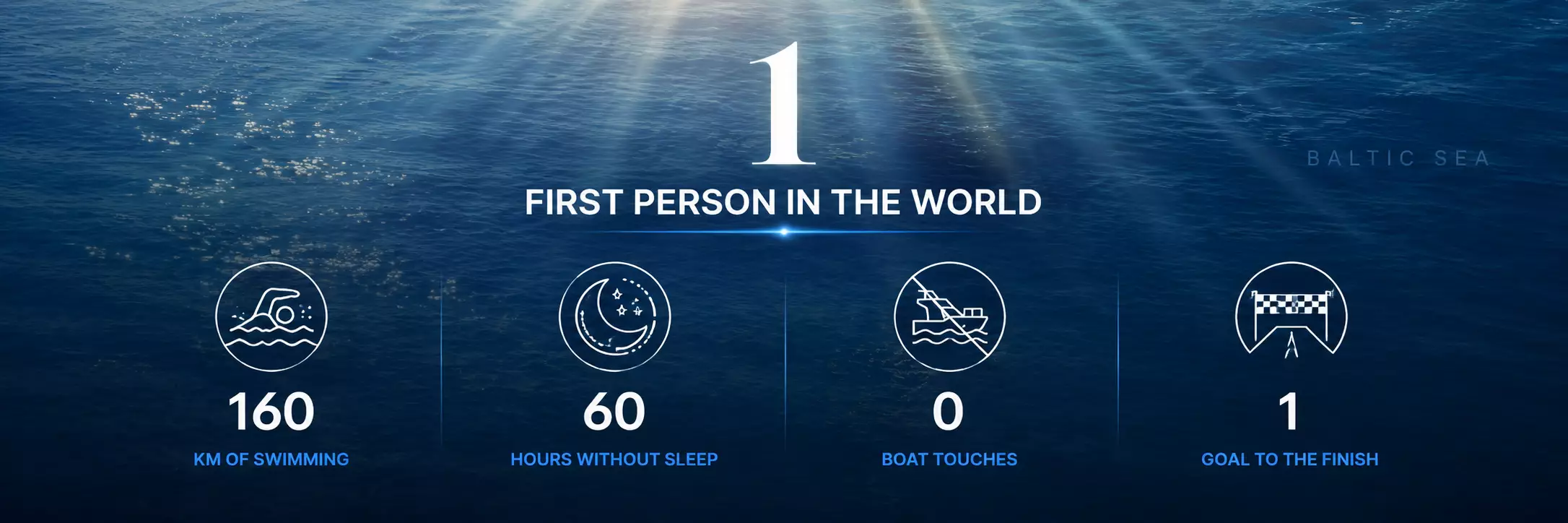
Bartłomiej Kubkowski achieved a feat that had long been his greatest sporting goal. After approximately 55 hours of uninterrupted swimming, he reached the Polish coast from Sweden, covering more than 160 kilometres of the open Baltic Sea.
He arrived in Dziwnów on 2 August 2026. For the attempt to be considered complete, he had to stand on the seabed unaided and walk out of the water. Simply reaching the shallows was not enough. Neither the waves nor the crews of the accompanying vessels could complete the final metres for him.
Kubkowski did not sleep for more than two days, did not board a boat and was not allowed to touch one. Food and drinks were passed to him from the support vessel. The boats were responsible for navigation, safety, monitoring his condition and providing logistical support, but he covered the entire distance solely through the strength of his own body.
A crossing of this kind cannot be reduced to a number of kilometres. The swimmer must battle waves, currents, wind, hypothermia, pain and a gradual loss of strength. The sea can push the athlete off course, while every change in the weather affects both his pace and his safety.
After several dozen hours, sleep deprivation becomes particularly dangerous. The body loses its ability to recover, and problems with concentration, orientation, and the proper assessment of the situation begin to appear. According to accounts from people involved in the expedition, Kubkowski went through severe crises and experienced moments of impaired contact with reality.
In such conditions, success is no longer determined by muscle strength alone. Mental resilience, nutritional preparation, navigation and a team capable of recognising the moment when continuing to swim becomes a threat to life are equally important.
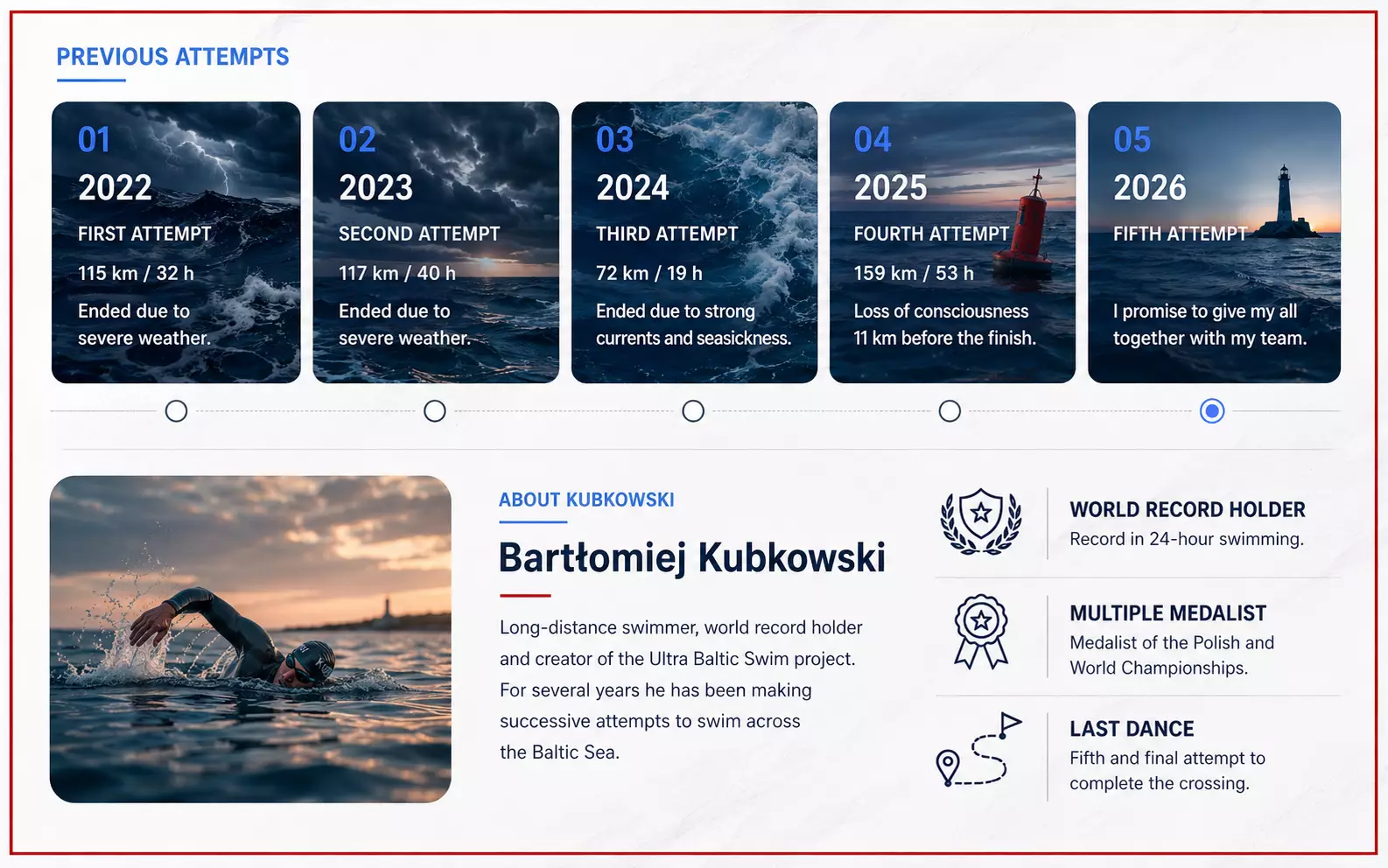
A year earlier, Kubkowski had come extraordinarily close to success. During his fourth attempt, he swam approximately 159 kilometres. Only 11 kilometres remained to Dziwnów, but his condition during the crossing forced the team to end the expedition.
It was a painful but responsible decision. In extreme sport, an athlete’s ambition cannot be more important than his life. Sometimes the greatest act of courage by a team is to stop a person who no longer wants to stop.
After that attempt, Kubkowski declared that he would not return to the Baltic. However, he could not come to terms with the fact that he had ended the project so close to the goal. The fifth attempt was meant to be the last.
It was not a path of straightforward progress. In previous years, his attempts had ended after he had covered more than 115, 116 and 71 kilometres respectively. Each expedition, however, brought new experience concerning the behaviour of the body, the weather, nutrition and the work of the crew.
The crossing was combined with a fundraising campaign for the Cancer Fighters Foundation, which supports people affected by cancer and their families. On the day the expedition ended, donations had exceeded several hundred thousand złoty, while thousands of people supported the campaign.
As a result, Ultra Baltic Swim was no longer merely the private dream of an athlete. The extreme effort became a way of drawing attention to people who face a daily struggle for their health and their lives.
In media reports, Kubkowski is sometimes described as the first person to swim across the Baltic Sea. Such a description, however, requires precision. The historic nature of his achievement concerns a continuous crossing from Sweden to Poland without boarding a boat, sleeping or receiving physical assistance from the support vessels. Other long-distance crossings had previously taken place in the waters of the Baltic Sea, which is why it is more responsible to speak of the first completion of this particular route in this particular format.
Kubkowski’s story can easily be reduced to the slogan: “Never give up.” That, however, would be too simplistic.
Kubkowski reached the shore not because he ignored the danger. He achieved his goal through years of preparation, analysis of earlier mistakes, the work of a professional team and a willingness to accept the decision to end an attempt when safety required it.
When he walked onto the beach in Dziwnów, four abandoned attempts, five years of preparation, thousands of hours of training and the memory of the 11 kilometres he had previously fallen short of all reached the shore with him.
He did not conquer the sea once and for all. The sea cannot be conquered. One can only prepare as well as possible, remain humble before it and hope that this time it will allow one to reach the shore.
It allowed Bartłomiej Kubkowski to do so.
Author/Editor: Maria Anna Furman