Articles
Content That Matters
Author/Editor Maria Anna Furman
Krakow holds a special place in my heart. I come from this city and have always felt safe there. I now live in the United Kingdom, and as I follow the news of the 7 November tragedy, I am trying to reconcile it with my image of a place so close to me. Its beauty is intertwined with the history of Poland’s kings and princes, with Wawel and the heritage preserved in its architecture and culture. It carries the dignity of a former capital alongside the everyday life of a modern city, where people work, meet and build their lives. Today, that ordinary life feels particularly precious. Being able to leave home without fear, arrange to meet someone in Kraków’s Main Square and return peacefully to everyday routines.
Living outside Poland often changes the way we think about our home city. News reaches us through a screen, yet it touches something deeply personal. When I read the names of Kraków’s streets, I see more than points on a map. I see a city to which I am connected by my roots and a sense of belonging.
I am not writing as a witness to Saturday’s events. I am writing as someone living in the United Kingdom, deeply moved by the suffering of people in her home city. I recognise that my emotions cannot be compared with the experiences of those who lost loved ones, were injured or found themselves in the line of fire.
Today, Monday 9 November, we know that the 24-year-old attacker has died. Police in the Małopolska region confirmed that he died in hospital in the early hours of the morning. After being shot during the police intervention, he remained in a critical condition and underwent several operations. Doctors were unable to save his life.
This news comes two days after the attack, which took place on Saturday at around 3 pm. The man drove into the Main Square and began shooting at people there. Six people were killed, and fifteen were injured, including two police officers. The attacker himself was also wounded. A tram in All Saints’ Square was also fired upon; neither the passengers nor the driver was injured.
Behind every sentence of this account lies someone’s experience. Behind the report of six deaths are six lives taken and the suffering of those who loved them. Those killed were four women and two men, citizens of Poland, the United Kingdom and Austria. We do not know all their stories. We do know, however, that each of them held a place in other people’s lives.
As someone living in the UK, I also find myself reflecting on the death of a British citizen. It connects the two countries that shape my life. It makes even clearer how far the consequences of violence committed in one place can reach. The suffering of families does not stop at the boundaries of a city or a country. For each family, this tragedy has its own deeply personal meaning.
I do not want to describe their pain as though I could know it. I would, however, like public discussion to leave them space free from intrusion, pressure and the expectation that they will share their most private experiences with us. Compassion also means respecting someone’s silence.
According to information provided by the Governor of the Małopolska region on Monday morning, fifteen people injured in the attack remain in six Kraków hospitals. Fourteen are described as being in stable condition; one of the police officers remains in serious condition. These reports offer hope, but they do not mean that the suffering is over. Those injured may face a long period of treatment and recovery. Their loved ones also need support.
Witnesses may also find Saturday afternoon distressing. Some may need help despite having suffered no physical injuries. The psychological support made available matters precisely because the effects of such an event cannot be judged solely by what is visible.
The tragedy also extends to Ostrowiec Świętokrzyski. The bodies of the attacker’s parents and 21-year-old sister were found in the family’s flat. According to the prosecution’s findings so far, the same person was responsible for their deaths and the attack in Kraków. Investigators are examining both incidents as part of a single investigation.
The attacker’s parents and sister were also victims. Their lives deserve to be remembered, and their loved ones deserve compassion.
Today, we owe particular gratitude to those who intervened and provided help. According to the regional governor, the first police patrol arrived at the scene less than three minutes after the incident was reported. Two officers were wounded while apprehending the attacker. Municipal guards, paramedics, firefighters and hospital teams were also involved in the response.
It is easy to write about courage. It is harder to imagine the decisions made in the face of immediate danger. Our gratitude towards these people should therefore include concern for their future wellbeing. For their treatment, the help they need and their families, who also experienced fear. Public recognition matters, but it means more when followed by practical support.
This situation can evoke difficult emotions. Doctors and nurses cared for a man responsible for immense suffering, trying to save the attacker’s life. Their efforts deserve respect. Such distressing circumstances reveal the significance of the responsibility borne by those entrusted with another person’s life.
The perpetrator’s death does not bring the investigation to an end. Prosecutors have announced that they will continue examining his motives and possible connections, as well as analysing the evidence secured. It will no longer be possible to obtain his account. The responsibility remains, however, to establish as fully as possible what happened and how these crimes came about.
The question naturally arises: why? It is a question I find myself asking too. I want to understand what led a young man to act this way. At the same time, I know that the need for answers can lead us to accept too quickly an explanation that only appears to make sense of events.
Prosecutors have classified the attack as a terrorist offence. The precise motives remain under investigation. The Minister of the Interior and Administration clarified that statements about the perpetrator’s possible radical views concerned hypotheses requiring verification. That is how they should be treated. Incomplete information should not lead us to assign him a diagnosis or draw conclusions about the influence of particular people or groups.
Access to firearms also requires serious discussion. The attacker and his father held firearms licences, and a total of eleven firearms were recovered in Kraków and at the family’s flat. Questions remain about how they were stored and used, and whether there were any earlier warning signs. We all want answers grounded in evidence. Only then will it be possible to assess whether procedures, compliance with them or other safeguards failed.
As Editor-in-Chief of Wyspa TV, I feel that the way we report this tragedy matters too. Families should not have to endure additional harm from rumours, graphic coverage, or hasty accusations. When reporting, we must leave questions open where answers have not yet been established. Respect for our audience includes honestly acknowledging the limits of our knowledge.
My thoughts return to Kraków, a beautiful city whose history is deeply intertwined with Poland's. Its royal heritage offers a sense of continuity, while familiar places help us recognise where we belong. Yet no history, however extraordinary, can protect people living today from suffering.
Did 7 November mark the end of a chapter? For me, it shook a certainty I had scarcely noticed before. I had always felt safe in Kraków. Now I wonder what emotions I will experience when I next return. That remains a personal question. It does not entitle me to declare that the entire city has become unsafe, or that all its residents feel the same way.
Nor do I want to deny anyone the right to feel afraid. Some people will need time before returning to the Main Square. Others will want to go there to be with people and pay tribute to the victims. Each of these responses deserves respect. No one should feel obliged to regain their peace of mind quickly.
From the United Kingdom, I feel a particularly strong connection today with the city I come from. Moving to another country does not erase that closeness. Kraków remains part of my identity, and news about its residents and visitors affects me differently from news about a place with which I have no connection. I want that personal perspective, however, to lead above all to greater consideration for those directly affected by the tragedy.
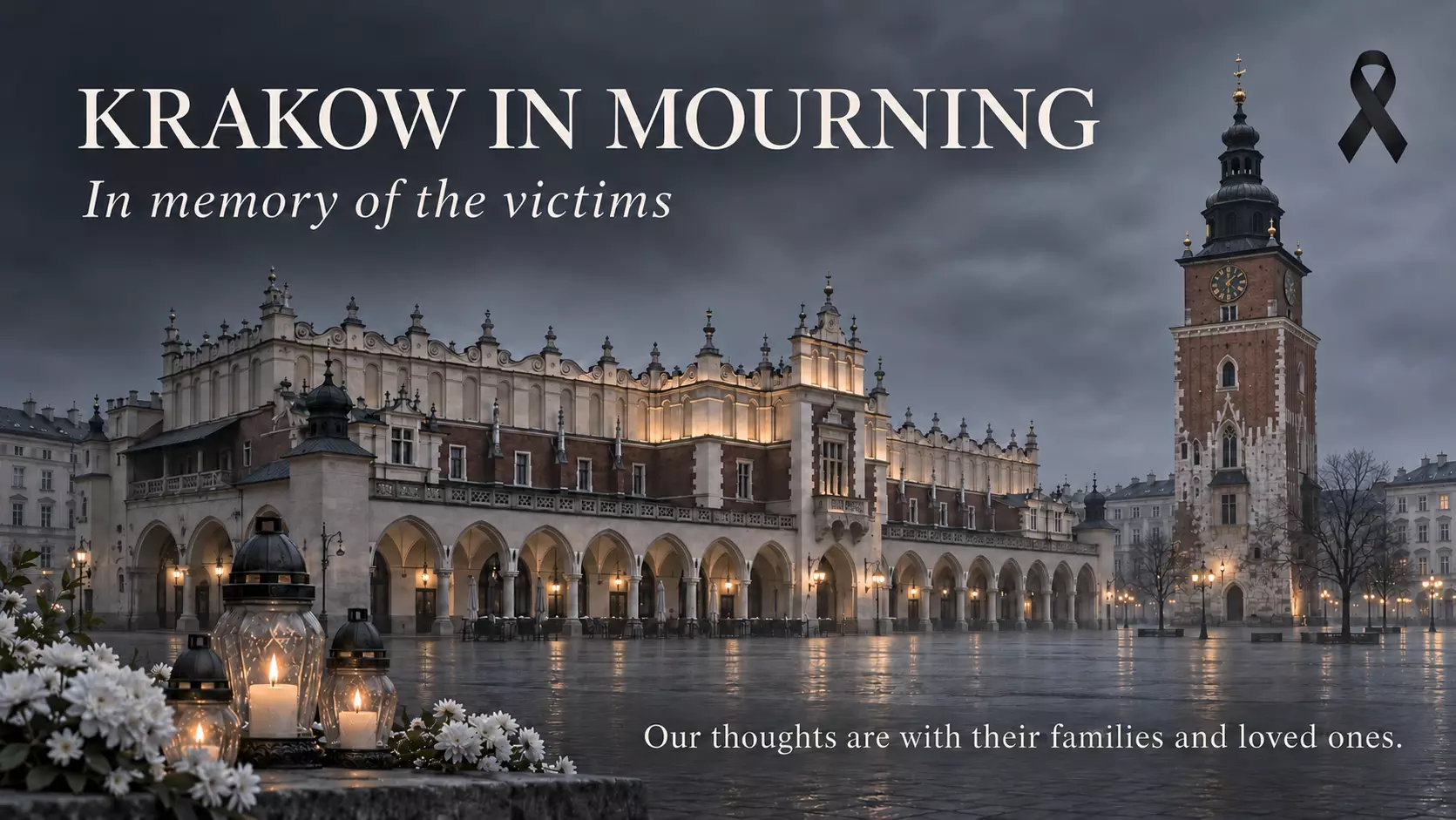
Today, Poland remains in national mourning, and Kraków has declared mourning until 11 November. Official mourning has a beginning and an end. For bereaved families, life will follow a different calendar. Help will still be needed when reports from Kraków no longer lead the news.
We extend our deepest condolences to the families and loved ones of all those who were murdered. I cannot find words that could lessen your loss. We acknowledge your pain with profound respect and hope that you receive the support you need, including in the weeks and months ahead.
We wish those injured a return to health and strength, and their loved ones the presence of people they can rely on. We express our deep gratitude to the police officers and everyone involved in saving lives. We hope that witnesses receive help and understanding, without pressure to feel that they should already have recovered their emotional balance.
I am writing this article from the United Kingdom, but my thoughts remain with Kraków. With the city of Poland’s kings and princes, which for me has always also been a place where I felt safe. Today, that connection carries many questions. Yet the connection remains.
Author/Editor Maria Anna Furman
Information current as of Monday, 9 November 2026.