
Interviews
Interviews & Podcasts
Former Lord Mayor of Liverpool 2025/26, Councillor Barbara Murray, on responsibility, education and the future of the city
Author/Editor Maria Anna Furman
Liverpool Town Hall is a place where history meets the present, and where the ceremonial nature of office is combined with everyday responsibility for the city and its residents. It was in this exceptional setting that Maria Anna Furman spoke with the Lord Mayor of Liverpool, Councillor Barbara Murray, a person who has been involved for many years in public life, education, the development of local communities and work supporting young people.
The interview was conducted in one of Liverpool’s most representative buildings. The historic interiors of the Town Hall, rich in symbols, portraits, historical inscriptions and places of remembrance, created a unique setting for a conversation about the essence of public service. However, this was not solely a story about the office and its ceremonial significance. Above all, it was a conversation about people, values and responsibility that does not end when a term of office comes to a close.
Cllr Barbara Murray emphasised that many years of experience in local government had prepared her to take on the role of Lord Mayor. For almost twenty years, she served as a councillor; she also worked in education, schools, employment, and the development of professional skills. These roles allowed her to better understand the challenges faced by Liverpool’s residents and the great importance of creating genuine opportunities for their development.
One of the most important topics of the conversation was education. According to Cllr Barbara Murray, it is one of the most effective ways to overcome poverty and build a better future. A good education increases the chances of stable employment, higher earnings, better health and greater independence in life. Liverpool continues to face social problems, including poverty and unemployment, but the nature of these challenges has changed over the years. Today, well-paid jobs are available in the city, but many residents lack the appropriate qualifications to take advantage of them.
The Lord Mayor drew particular attention to the need to develop vocational placements and apprenticeship programmes. In her view, young people should receive not only the opportunity to gain a profession, but also genuine financial support during their training. She emphasised that businesses can play an enormous role in this process by employing apprentices, sponsoring their wages or supporting training in professions where the greatest skills shortages exist.
Initiatives connected with education, literacy, poetry and the development of young people became an important part of Cllr Barbara Murray’s term of office. She carried out fundraising activities in support of Liverpool Literacy, Liverpool Poetry Space and Youth Worker Apprenticeships. As she pointed out, however, the most important objective is not merely to raise a particular amount of money, but to convince others that these are matters requiring long-term attention and shared commitment.
The subject of young people was particularly moving. Cllr Barbara Murray recalled that Liverpool City Council once employed 88 youth workers, whereas today only two remain. In her view, the scale of young people’s needs is now enormous. Mental health problems, the pressure of social media, economic difficulties and the lack of appropriate support mean that investment in the younger generation should become one of the city’s most important priorities.
The conversation also concerned creativity and culture. Cllr Barbara Murray wrote poetry for many years, created works of art and taught art. She drew attention to Liverpool’s strong poetic traditions and to the importance of creativity in the life of the city. She mentioned the Mersey Poets and the fact that poetry is still present in local clubs, pubs and at open mic events.
In her opinion, young people today should think boldly about working in the creative sectors. Liverpool is developing its film industry, art, music, dance and theatre. What was once treated as a hobby can now become a fully recognised and rewarding professional career.
Cllr Barbara Murray also spoke about the personal significance of the role of Lord Mayor. She admitted that she had not originally planned to take on the position. Her main ambition had been to serve as a councillor. However, when the position was offered to her again in 2025, she accepted it without hesitation, regarding it as a great honour.
The historic Lord Mayor’s chain, which is around 200 years old, holds particular significance for her. The names of previous office holders are engraved on its links, and her name will also be added. As she emphasised, this is a personal honour and a symbol of becoming permanently inscribed in the history of Liverpool.
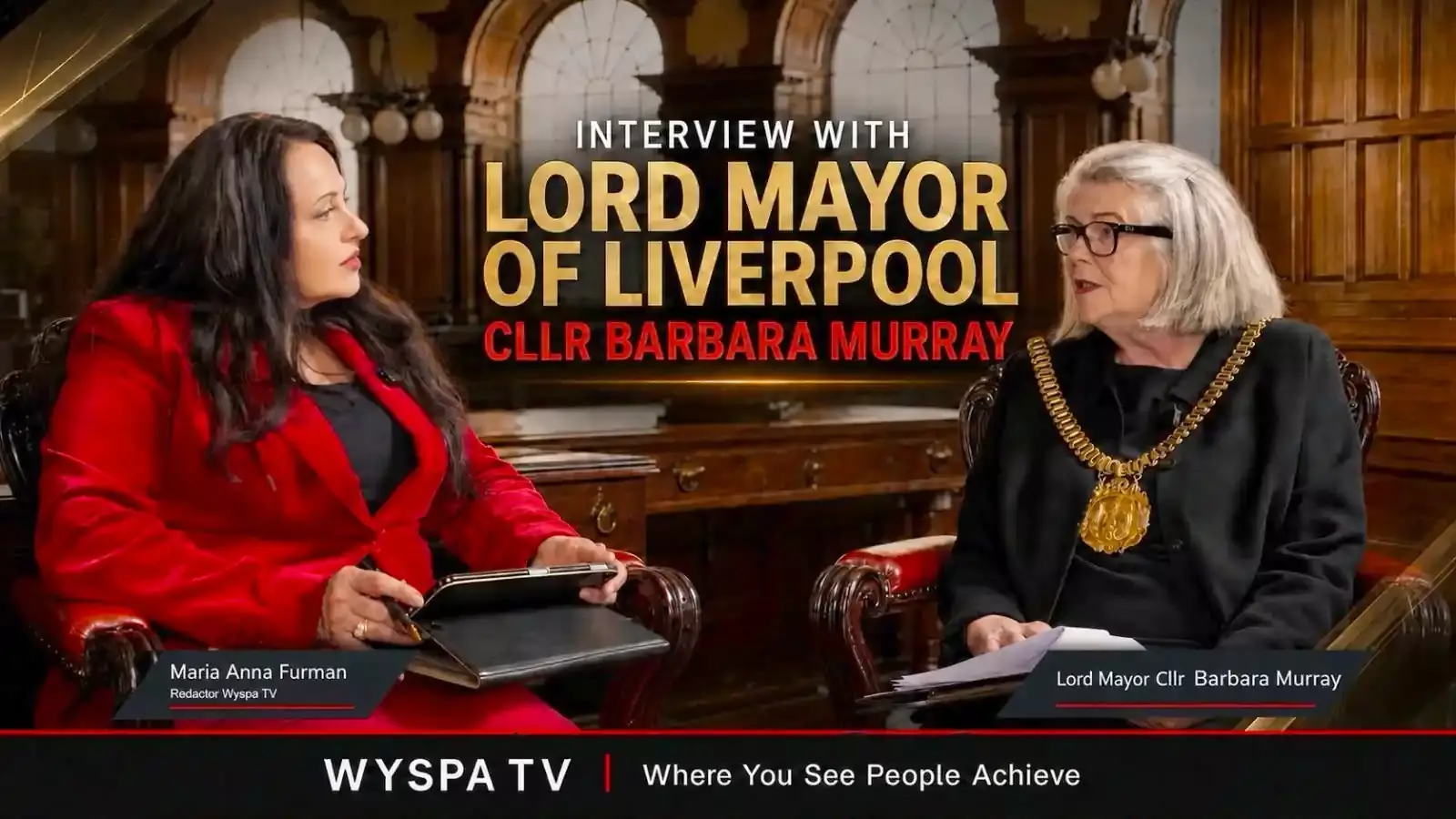
During the conversation, the Lord Mayor also spoke about the role of the city’s first citizen. This position requires representing Liverpool, welcoming guests, attending ceremonies, meeting consuls and ambassadors, chairing City Council meetings and taking part in citizenship ceremonies. It is also connected with the duty of remembrance, laying wreaths and representing the city during important historical and state occasions.
One of the most emotional moments of her term was laying a wreath at Anfield following the tragic death of a young Liverpool player. She recalled that the atmosphere of grief was almost palpable. Equally moving for her were ceremonies commemorating the victims of wars, citizenship ceremonies and meetings with both younger and older residents of the city.
During the interview, Liverpool Town Hall became not only the setting, but also an important character in the story. Debates take place in the Council Chamber, and decisions are made there concerning the everyday functioning of the city, education, public health, transport, housing, roads, municipal services and the wellbeing of residents. The meetings are public and streamed online, emphasising the importance of transparency and citizen participation in democratic life.
In the Hall of Remembrance, Cllr Barbara Murray spoke about the names of soldiers from Liverpool who died during the First World War. She drew attention to their young age and to the fact that the list of the fallen is still being updated when families discover new information. This place is a reminder that historical remembrance is not merely a ceremonial duty, but an important element of public responsibility.
Concluding the conversation, Cllr Barbara Murray emphasised that the most important part of her term had been the residents of Liverpool. It was meeting people, their kindness, sense of humour, commitment and community work that made the year so exceptional. In her view, Liverpool is in a much better position today than it was twenty years ago, but it still has the potential to develop even further.
After the end of her term, Cllr Barbara Murray intends to continue supporting education, poetry, literacy and vocational opportunities for young people. She also plans to create an online archive of her work and to maintain a fund supporting community initiatives.
The conversation at Liverpool Town Hall was therefore not only a summary of a term of office, but also a testimony to the belief that public service should be based on kindness, responsibility, cooperation and genuine concern for the future of residents. Cllr Barbara Murray leaves behind the message that investing in education, creativity and the younger generation is the best investment in the future of the whole of Liverpool.
Author/Editor: Maria Anna Furman