Articles
Content That Matters

Author/Editor Maria Anna Furman
In the space of personal development and public narratives, we often repeat a phrase that sounds beautiful, mature, and almost spiritual: “the wiser one steps aside.” In theory, it is meant to protect us from conflict and allow us to maintain dignity in the face of injustice. In practice, however, it increasingly becomes a convenient excuse to remain silent precisely where silence begins to cause harm.
Gossip is one of the most underestimated mechanisms of social influence. Not because it is loud, but precisely because it operates quietly.
It does not shout. It whispers.
And for that reason, it can sometimes be more effective than open conflict.
Gossip begins with emotion.
It most often emerges during moments of change, when relationships are redefined, a project grows, someone must make difficult decisions, and a community space transforms into a structure of responsibility.
It is natural that not everyone adapts easily to this transformation. What is less natural is that contemporary culture has taught us to romanticise the silence of the person being attacked, while simultaneously minimising the responsibility of those who repeat unverified stories.
Gossip ceases to be an innocent conversation when it begins to shape perceptions of reality.
One of the most harmful beliefs is the idea that truth will always prevail without our intervention. It is merely a beautiful metaphor.
The human brain does not function like an impartial judge. It operates as an interpretive system that fills informational gaps with whatever is most emotionally available. If one narrative is repeated while the other remains silent, audiences unconsciously begin to perceive the first as more accessible and therefore more credible.
The boundary between dignity and silent resignation is thin and far too rarely discussed.
Gossip rarely exists in public spaces. Its natural environment consists of private conversations, messages shared “in confidence,” and phone calls filled with suggestions and implications.
Why?
Because privacy gives a narrative the illusion of authenticity.
“I’m telling you this just between us” sounds more convincing than any official statement.
In this way, an alternative reality emerges not necessarily grounded in facts, but coherent enough to begin to influence others' decisions.
Every growing project reaches a point at which relationships cease to be purely friendly and assume a structural form.
Decisions appear. Boundaries. Standards. And sometimes the necessity of saying “NO.”
This is the moment when a leader stops being merely an organiser and becomes a symbol of direction. And symbols always attract interpretation, not all of it benevolent.
Those who lose their place within a project or their sense of influence naturally seek ways to regain narrative balance, a process often referred to as identity protection. In practice, this frequently manifests as a reinterpretation of events.
The most uncomfortable truth about gossip is this: its power does not come from the person who starts it. It comes from those who receive it.
Each of us faces a moment of choice: to repeat the story or to ask at the source.
The culture of communication will not change as long as responsibility for gossip rests solely with the author rather than with the entire chain of receivers.
The time has come to stop repeating that “the wiser one steps aside.”
True wisdom does not lie in disappearing. It lies in setting boundaries calmly and clearly. In having the courage to say:
“This is not aligned with the facts.”
Gossip will always exist, just as emotions, conflicts, and human interpretations do.
But we can stop treating silence as the only sign of class and instead recognise responsible response as a sign of maturity.
We can also learn that true leadership does not lie in avoiding difficult conversations but in giving them meaning.
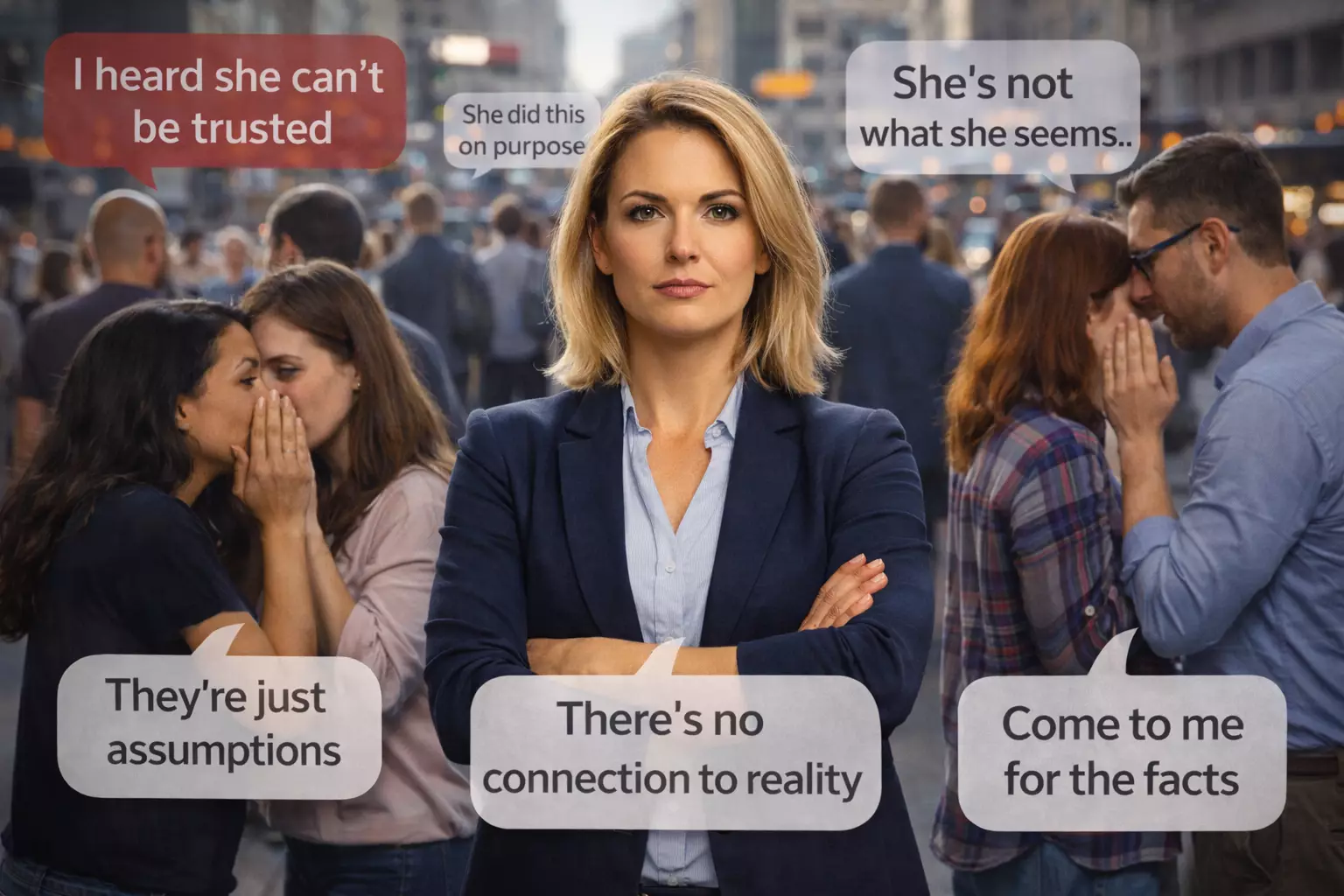
One of the most frequently overlooked aspects of the conversation about gossip is not the question of who starts it, but who receives it. In social reality, gossip never operates in a vacuum. Its power does not come solely from the intentions of the person who speaks it, but from the reactions of those who hear it.
It is the audience that ultimately decides whether a given narrative becomes a temporary informational noise or begins to take on a life of its own.
There is no single group of “people who believed.” There are different types of recipients, and each reacts for different reasons. Understanding this distinction alters how we perceive the situation as a whole. Suddenly, it becomes clear that not every change in relationships signifies hostility, not every withdrawal is a judgment, and not every action is driven by a search for truth.
Within the dynamics of gossip, three characteristic types of recipients can be identified:
Type One “Passive recipients” (the largest and most receptive group)
These are individuals who do not hold strong personal opinions. They listen to what reaches them but rarely verify information actively. They are not directed against anyone; rather, they operate almost passively, and their responses stem from a natural need to simplify reality. The human brain seeks the simplest narrative. If it hears only one version of events, it begins to treat it as the most probable, not because it is true, but because it is available.
Such recipients can be recognised through subtle shifts: they suddenly become more neutral, react less, or withdraw from interaction. This does not necessarily indicate hostility. More often, it reflects uncertainty about how they should respond.
Type Two “Cautious observers”
This is a particularly important, though less visible, group. These are individuals who have heard something but do not want to enter into conflict or take sides. Instead, they observe how the leader responds.
Often these are partners, influential individuals, and experienced, pragmatic people who ask themselves one central question: Can the leader manage a crisis effectively?
Type Three “Active amplifiers of gossip”
The smallest in number, yet the most visible group. These individuals pass information, are drawn to drama, and often derive energy from social tension.
The most important rule: do not try to convince them. Their goal is rarely truth itself. Attempting to engage in argument only increases the energy of conflict.
The strongest strategy remains emotional neutrality, avoiding polemics, and demonstrating clear, calm boundaries.
Understanding these three types shifts perspective entirely. It becomes evident that a leader’s response is not about fighting people, but about managing the space of interpretation. Gossip will not disappear, but its influence can be reduced through conscious framing of communication.
Ultimately, it is not gossip that determines reality, but the way a leader can contain and navigate it.
Author/Editor Maria Anna Furman